The biggest microfiber towel bulk pack can still be the wrong buy. A large stack won’t help if the towels leave glass streaky, feel too rough for delicate surfaces, or build up faster than you can wash them. A smart purchase matches the towel types to your tasks and the quantity to your cleaning routine.
Comparing packs can get confusing quickly. GSM, fabric blend, weave, size, and towel count all matter, but none tells the whole story on its own. General-purpose towels may handle everyday wiping, but they aren’t automatically right for glass, drying, polishing, or every surface at home or work.
This guide explains what those specifications mean in practice, how to match towel construction and format to the job, and how to estimate a useful quantity based on cleaning frequency and laundry turnover. You’ll also find simple ways to sort and care for towels so the right ones are ready when you need them. The goal is a better-matched bulk purchase, not a stack you can’t use.
Key Takeaways
- Choose a microfiber towel bulk pack by matching its towel types to your cleaning tasks, not by pack size alone.
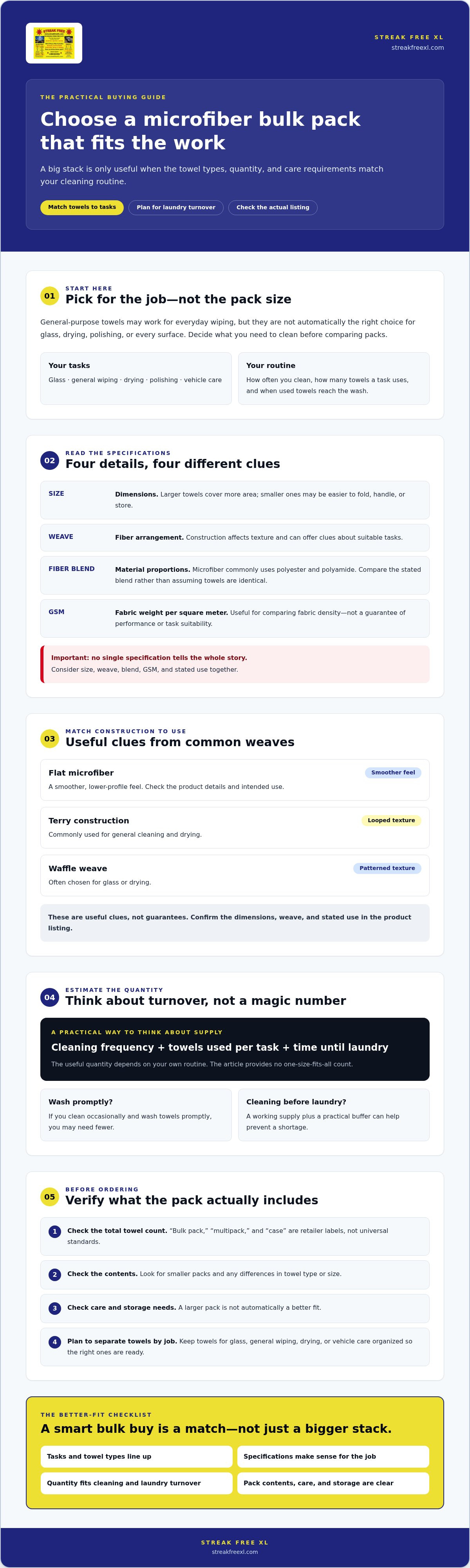
- Compare size, weave, fabric blend, and GSM. Treat GSM as fabric weight, not a guarantee of performance.
- Separate towels by job, such as glass, general wiping, drying, or vehicle care, to keep your supply organized.
- Estimate your needs from task frequency and laundry turnover, then add a practical buffer instead of relying on a one-size-fits-all quantity.
- Check care and storage needs before buying. A larger pack isn’t automatically a better fit.
What Is a Microfiber Towel Bulk Pack, and Who Is It For?
A microfiber towel bulk pack is a multi-towel purchase intended to provide several towels for repeated cleaning tasks. There’s no single standard pack size, so check the listed count and towel details before deciding whether it fits your routine.
Microfiber refers to very fine fibers, commonly made from materials such as polyester and polyamide. For more background on the material, see What is microfiber. The label alone doesn’t tell you whether a towel suits glass, general wiping, or vehicle care. Construction and stated use matter too.
A multipack may suit someone who cleans frequently at home or wants separate towels for different surfaces. Detailers and teams with recurring cleaning tasks may need a larger or more varied supply, but a household multipack and a wholesale order aren’t automatically the same thing. A multipack describes multiple towels sold together; wholesale usually refers to purchasing for business or resale, where commercial suppliers like Cleaners Hub provide materials tailored for professional operations. Check the seller’s terms and what’s included rather than assuming the label explains the order.
There’s no magic number that fits everyone. The useful quantity depends on how often you clean, how many towels each task uses, how quickly used towels go into the wash, and how often you do laundry. A frequent cleaner who separates towels for glass and counters will have different needs from someone who wipes a surface occasionally.
When Does Buying Microfiber Towels in Bulk Make Sense?
Buying multiple towels can make sense when you clean often and want clean ones ready while used towels wait for laundry. It can also help keep tasks organized: set aside particular towels for glass, general wiping, or vehicle care instead of reaching for whichever towel is nearby.
Think about turnover, not just the pack count. If you clean occasionally and wash towels promptly, you may need fewer. If you clean repeatedly before laundry day, a working supply plus a small buffer can help prevent a shortage.
Bulk Pack, Multipack, or Case: What Is the Difference?
“Bulk pack,” “multipack,” and “case” are retailer packaging labels, not universal standards for towel count or format. One listing might group smaller packs together; another might describe a collection of individual towels. Don’t rely on the label to tell you what will arrive.
Check the product description for the total towel count, whether smaller packs are included, and whether the towels differ in type or size. That’s the practical way to compare listings and avoid ordering more, or less, than your routine calls for.
How to Compare Microfiber Towels: Size, Weave, Blend, and GSM
A product listing can provide plenty of numbers without making the choice clearer. Start by asking what each detail tells you about handling and intended use. When comparing a microfiber towel bulk pack, match its specifications to the surfaces and tasks you have, rather than looking for one supposedly perfect towel.
| Specification | What it describes | Why it matters to you |
|---|---|---|
| Size | The towel’s dimensions | Larger towels cover more area, while smaller ones may be easier to fold, handle, or store. |
| Weave | How the fibers are arranged | Texture and construction affect how the towel feels and which tasks it may suit. |
| Fiber blend | The proportions of materials, often polyester and polyamide | Blend details help you compare products. Don’t assume two microfiber towels are identical. |
| GSM | Fabric weight in grams per square meter | Useful for comparing fabric density, but not enough to predict task suitability by itself. |
What Do Towel Size and Weave Tell You?
A larger towel can cover more surface, which may be handy for broad wiping or drying. It can also take up more storage space and feel cumbersome for smaller jobs. Flat microfiber has a smoother, lower-profile feel; terry construction has a looped texture and is commonly used for general cleaning and drying; waffle weave has a patterned texture often chosen for glass or drying. These are useful clues, not guarantees. Check the dimensions and weave in each product listing.
Weave is one part of the decision. For a plain-language explanation of how microfiber cloths work, the material’s fine fibers help explain why construction and task can matter in practice.
Does GSM or Fiber Blend Determine Which Towel Is Best?
Not on its own. GSM measures fabric weight per area, so it describes how much the fabric weighs across a set area, not whether it will clean glass well or suit a delicate finish. A higher GSM may indicate denser fabric, but the towel’s weave, fiber blend, size, and intended use also affect how it handles a task. GSM alone cannot determine a towel’s performance because weight doesn’t specify its dimensions, weave, fiber proportions, or suitability for a particular surface.
Microfiber products may use different proportions of polyester and polyamide. Compare the stated blend where available, then match the full set of specifications to your job instead of focusing on a single number. To explore specialized cleaning textiles, you can browse cleaning cloth options from Streak Free XL.
Which Microfiber Towel Bulk Pack Fits Glass, General Cleaning, or Car Care?
Start with the jobs, not the bundle. Glass, everyday wiping, drying, and vehicle care can call for different towel characteristics, so a mixed-use supply may need more than one type. Before comparing a microfiber towel bulk pack, list the surfaces you clean and what each task requires. This helps you avoid buying a stack that looks convenient but doesn’t suit the work.
- Glass: Look for product guidance that identifies the towel for glass, where a smooth finish and minimal lint are often priorities.
- General cleaning: Choose a format that’s comfortable for routine wiping across the surfaces you actually handle.
- Drying: Check whether the listing describes the towel as intended for drying and whether its size and absorbency suit the job.
- Vehicle care: Separate towels for windows, drying, and other vehicle surfaces if the product instructions call for different uses.
These are selection cues, not performance guarantees. Read the item’s stated use and care instructions, especially before using a towel on a delicate finish. For vehicle windows, the streak-free car window cloth guide offers a focused walkthrough. For repeated workplace use, apply the same checks to the intended task, towel details, and care guidance.
Should You Buy One Towel Type or a Mix?
One type may be the straightforward choice if your tasks are consistent and the towel’s stated specifications clearly match them. A mix can make more sense when you move between glass, general wiping, and drying. Assigning towels by task helps reduce accidental cross-use and makes sorting after cleaning easier.
Make a quick list of the surfaces you clean, such as windows, counters, fixtures, vehicle paint, or other areas. Then compare that list with the stated purpose and contents of each pack. Don’t assume an assortment covers every job just because it includes several towel types.
How Do You Choose Towels for Glass and Vehicle Care?
Glass care may prioritize a clean finish, while drying focuses more on absorbing water. Those needs can differ, even on the same vehicle. Check the product description for its intended surface and follow any guidance for delicate finishes. Keep glass towels separate from towels used on other vehicle areas, and review microfiber care guidelines for practical handling reminders. A task-based mix is useful only when every included towel has a clear job.
How Many Microfiber Towels Should You Buy, and How Should You Care for Them?
The right count comes from your workload and laundry rhythm, not from choosing the largest case. Use this quick method to estimate a useful quantity for your microfiber towel bulk pack:
- List the tasks. Note the cleaning jobs you repeat and which towels need to stay separate.
- Estimate towels per session. Count how many you typically use for each task before switching to a clean towel.
- Account for laundry. Consider how many sessions happen before washing, and how long used towels are unavailable while they’re washed and dried.
- Add a modest buffer. Include a few extra only if real use suggests you’ll need them, rather than defaulting to the biggest available case.
Here’s a hypothetical calculation, not a universal recommendation: if a routine takes four towels per session and you complete two sessions before the next laundry load, you’d need eight towels for that interval. You might add two as a reserve, making ten for this example. If your routine, laundry timing, or towel use changes, recalculate. Track actual use for a short period and adjust before ordering more.
How Can You Estimate a Useful Towel Quantity?
Think in terms of clean towels available between wash loads. Someone cleaning one area occasionally may use only a few before laundry; a team completing repeated tasks may cycle through its supply faster. Include towels set aside for specific jobs, too. That way, your estimate reflects both turnover and how you keep tasks separate.
How Do You Wash and Store Microfiber Towels?
Care instructions can differ by product, so check the manufacturer’s label or listing for washing and drying directions. Don’t assume one temperature, detergent, or fabric-softener rule applies to every towel. Follow the specific guidance for the textiles you buy.
Keep used towels sorted by task, then store clean ones in clearly labeled, separate bins or shelves. Labels help everyone return towels to the right place and reduce accidental cross-use. Keep clean stock separate from used towels, and arrange storage so you can see what’s ready to use. A simple system makes your towel quantity easier to manage.
Looking for cleaning textiles to compare against your task list? Explore Streak Free XL’s cleaning textiles, then check each item’s product details and care guidance before choosing.
How to Choose a Microfiber Towel Bulk Pack Without Buying the Wrong Fit
A bigger pack isn’t automatically better value, and it won’t solve a mismatch between the towel and the job. Choose for the work you actually do. Before ordering, run through this checklist:
- Intended tasks: List the surfaces and jobs the towels need to handle, such as glass, general wiping, drying, or vehicle care.
- Towel format: Match the size and construction to the way you’ll use, fold, handle, and store each towel.
- Verified specifications: Check the current listing for dimensions, weave, fiber blend, GSM, and stated use. Don’t treat one specification as proof of overall suitability.
- Quantity: Estimate how many towels you use between laundry loads, then choose a practical reserve based on actual turnover.
- Care and storage: Read the product’s care instructions and make sure you have room to store clean towels separately by task.
That’s the core decision: fit the towels to the jobs, and the quantity to your routine. A microfiber towel bulk pack that contains more towels than you can use, wash, or store sensibly may not be the right choice, even if the count looks appealing.
What Should You Check Before You Order?
Read the product description closely. Confirm the towel count, size, construction, and intended use. Then check whether the displayed quantity means one pack or several smaller packs grouped together. Packaging labels can be vague, so use the listing details to understand exactly what’s included.
Finally, consider the practical side. Will your washing routine keep enough clean towels available? Do you have a suitable place to store them, separated by task if needed? If not, adjust the quantity or storage plan before ordering. A quick check now can prevent an unsuitable stack later.
Where Can Streak Free XL Fit Into Your Search?
Streak Free XL offers cleaning textiles including Streakfree towels and Magic cleaning cloths. Its products are designed for effective surface cleaning without requiring chemical cleaning solutions or professional cleaning services. Check current product details rather than assuming a specific item is sold in a bulk pack or suits a particular surface.
Ready to compare what’s available? Explore Streak Free XL cleaning textiles and review each listing’s contents and care guidance to see what may fit your needs.
Build a Towel Supply That Fits Your Work
The right microfiber towel bulk pack isn’t necessarily the biggest one. It’s the one that matches your tasks, surfaces, and laundry routine. Compare size, weave, blend, and GSM together, then check the product listing to confirm exactly what’s included and how to care for it.
Keep your supply practical. Estimate how many towels you use between washes, add a sensible reserve based on real turnover, and sort clean towels by task so the right one is ready when you need it. A little planning can help prevent both shortages and unused stacks.
Streak Free XL offers cleaning textiles including Streakfree towels and Magic cleaning cloths. Check current product details to see what fits your needs, without assuming a particular item comes in a bulk pack. Explore Streak Free XL cleaning textiles and take the next step toward a better-matched supply.
Frequently Asked Questions
What is a microfiber towel bulk pack?
A microfiber towel bulk pack is a purchase containing multiple towels, with no single standard count or format. The pack might include one towel type or a mix, so check the listing for the exact contents, dimensions, construction, and intended uses. “Bulk pack,” “multipack,” and “case” are retailer labels, not guaranteed quantities. Choose based on the cleaning jobs you need to cover, not the packaging term alone.
How many microfiber towels should I buy in a bulk pack?
Buy enough to cover your cleaning tasks between laundry loads, plus a modest reserve based on real use. List your regular jobs, estimate how many towels each takes, and account for how long used towels are unavailable while washing and drying. For example, if you use four towels per session and clean twice before laundry, plan for those eight towels and decide whether a few extras make sense for your routine.
Is a higher GSM microfiber towel always better?
No. GSM measures fabric weight per square meter, but it doesn’t guarantee quality or suitability for a particular task. A heavier towel may feel denser, yet weave, size, fiber blend, and the surface you’re cleaning all matter too. Compare the full specifications and product guidance. A towel chosen for its stated use is a better bet than simply picking the listing with the highest GSM number.
Can one microfiber towel work for glass, cars, and general cleaning?
Sometimes a towel may be suitable for more than one task, but don’t assume a single type is right for every surface. Glass care may prioritize a clean finish, while drying calls for different handling needs; vehicle surfaces may also have specific care guidance. Check the manufacturer’s stated uses, especially for delicate finishes. Keeping separate towels for glass, general wiping, and vehicle care can also help prevent accidental cross-use.
What should I compare when buying microfiber towels in bulk?
Compare the intended use, dimensions, weave, fiber blend, GSM, and total towel count. Check whether the listed quantity refers to one pack or several smaller packs grouped together, and confirm that the specifications apply to the towels included. Then consider laundry turnover, storage space, and the product’s care instructions. A larger pack isn’t automatically a better fit if its towels don’t match your tasks or your routine.
How do you wash microfiber towels so they stay usable?
Follow the washing and drying instructions provided for the specific towel. Care requirements can vary, so don’t assume one temperature, detergent, or fabric-softener rule applies to every product. Sort towels by task before washing and keep clean towels separated in clearly labeled storage. That makes it easier to return each towel to its intended use and helps you see how much clean stock is ready between laundry loads.
Does Streak Free XL sell microfiber towel bulk packs?
Streak Free XL sells Streakfree towels, Magic cleaning cloths, the Zap cloth, the Ultimate cleaning cloth, and the Holy moly cloth. A specific microfiber towel bulk pack, case size, or bundle isn’t confirmed. Check the current product listings for available formats, quantities, and care details before ordering. Don’t assume a named product is offered as a bulk pack unless the listing says so.